
Seller Financing & Subject-To
Creative Financing Analysis
Win the Rental on Terms When You Cannot Win on Price
Enter the asking price and the seller's situation. Get the purchase price, the cash at closing, the note rate, the amortization and the balloon that still hit the cash-on-cash return you need on a long-term rental - plus a one-page owner financing proposal the seller can actually say yes to.


The seller's situation in, the terms out, a proposal they can read
Most sellers who turn down a cash offer are not turning down the money. They are turning down the number. Terms move the number without moving your return.
Three Answers Decide the Whole Offer
There is no spreadsheet to build and no amortization table to wrestle with. Answer what you already know about the property and the seller, and every term - price, down payment, interest rate, amortization and balloon - is solved backwards from the rental return you set.
The property and the asking price
Start from the address. Size, beds, baths, taxes and insurance fill themselves in, and the asking price becomes the number every offer is measured against.
What the seller owes
Owned outright, or still paying a lender? For a mortgage, the balance, rate, years left and what leaves their account each month - including whatever the lender escrows.
The return you need
The cash-on-cash you want from a long-term rental, and the least monthly cash flow you will accept. Those two numbers are what the price, the rate and the term are all solved against.
Every Number You Need to Make the Call
Real output from a real seller financing analysis on a single-family rental. Nothing below is a mock-up.

Your Pipeline
Every Seller Financing Deal You Have Built, in One Place
Creative real estate deals move slowly and in parallel. Smart Rental Investor keeps each one intact, so a seller who calls back in March meets the same numbers you quoted in January.
- The asking price, whether the owner is free and clear or still paying a lender, and the offer you landed on
- The recommended structure and its cash-on-cash return, without opening the deal
- Filter by seller situation and sort as the pipeline grows, with every assumption where you left it
The Offer
The Price to Offer, and What It Costs You
A price on its own tells a seller nothing about a creative deal. Every term is solved together, so you can name all of them in one sentence when they ask.
- The exact number to put in front of the seller, and why it is not the asking price
- The cash it takes out of your pocket on closing day
- What the seller carries, at what rate, over how long, and when it falls due

The Cash Flow
See Which Expense Is Eating the Deal
When a deal is thin you need to know which line is responsible before you negotiate. The arithmetic is on the page rather than behind it.
- Rent, then every cost against it, down to what you keep each month
- Taxes, insurance, vacancy, repairs, capital and management, each on its own line
- How much room is left on the rate before the deal stops working for you

Every Price
Answer the Counter-Offer Before It Arrives
Sellers counter. The only question is whether you can answer in the room or have to go away and rebuild the numbers first.
- Prices either side of yours, each solved on its own terms rather than scaled up or down
- What you keep every month at each one, and what your cash earns there
- The prices that stop working, marked, so walking away is a number and not a feeling

Why Terms at All
Prove the Asking Price Cannot Work on a Mortgage
Whoever funds your side, and the seller themselves, will ask why you do not simply get a bank loan. The answer is a table, not an argument.
- The same property on an ordinary mortgage at the asking price, line for line
- Both returns side by side, down to the debt coverage a lender underwrites to
- The price a conventional buyer would actually need, in dollars, before the rental works
- What the seller's note costs you over its life, and the day it is paid off

Subject-To
Take Over a 3% Mortgage Instead of Buying a 7% One
A seller still paying a low-rate loan holds something no lender will sell you today. Smart Rental Investor prices that mortgage as the asset it is, so only the equity on top is up for negotiation.
- The existing mortgage taken over at its own rate, payment and remaining term
- Principal and interest separated from the escrowed taxes and insurance the seller also pays
- Monthly rental cash flow and cash-on-cash return measured after both payments

The Equity
Split What They Own Between Cash Now and a Note
The gap between the loan balance and the price is the only part you actually negotiate. Paying it over time rather than at closing is what keeps a buy-and-hold rental cash-flowing from the first month.
- The balance left in the seller's name, at its original rate and years remaining
- The seller carryback note they take instead of cash, with its rate, amortization and balloon
- How much rate is left to give before the rental stops meeting your target

Against a Bank Loan
The Same Rental, Financed Two Ways
Anyone backing your side will ask why you did not simply get a mortgage. Smart Rental Investor answers it as a table: one property, one rent, two sets of financing.
- Cash to close, rent, operating expenses and debt service on both routes, line for line
- Monthly cash flow, cash-on-cash, cap rate and DSCR side by side
- Taxes and insurance projected from the new value, never copied from the seller's escrow

Over the Hold
Know Every Payment Before You Commit to It
A long-term hold lives or dies on what the notes do over the years, not on the first month. The whole amortization is settled the day the offer is written.
- How each carryback payment splits between principal and interest across the term
- The balance still outstanding on the day a balloon falls due, years before it does
- The assumed loan's balance, payment, rate and years remaining, kept on their own lines

Why Terms at All
Prove the Asking Price Cannot Cash Flow
Sellers rarely believe their price is unreachable until someone shows them the arithmetic of the buyer they are waiting for.
- Prices either side of your offer, with the cash flow and return each one leaves you
- What the asking price does to a buyer on an ordinary twenty per cent down mortgage
- The price that buyer would actually need, in dollars, before the rental works
Their Side of the Table
Show the Seller What They Actually Get
Sellers say no to prices and yes to totals. Their side of the deal is written in their terms, so the conversation stops being an argument about one number.
- Cash at closing, monthly income and interest earned over the note
- The same deal against a retail sale after commission
- And against what a typical cash investor would hand them

Before You Send It
Know How the Offer Will Land
A weak score is not a reason to abandon an offer. It tells you which part to lead with, and which part the seller is most likely to push back on.
- A score for how the terms look from the seller's chair
- What is driving it: the price, the cash asked of them, the rate, the term
- Whether to lead with the price or with the total

Paid Over Time
Show a Seller the Whole Thirty Years
A seller weighing an offer against a cash sale is comparing one cheque with a promise. Drawn out year by year, the promise stops being abstract.
- Everything they receive, from the cheque at closing to the last payment
- How the total climbs past what a cash buyer would have handed them, and when
- A balloon, if there is one, shown as the date and the amount it lands
Nothing You Cannot Defend
An offer above the asking price only stands up if the value and the rent behind it do.

What It Is Worth
The Sales Your Price Rests On
Paying more than a cash buyer only makes sense when the property supports it. The proof sits beside the number rather than in another tab.
- Nearby sales on a map, with the subject property marked
- The weighted value, the average price per square foot and how close the matches are
- Evidence a partner or a lender will ask for, already assembled

Correct It Yourself
Drop a Comp and the Offer Rebuilds
You know the street better than any model does. Removing a sale that does not belong takes one click and rewrites the offer underneath it.
- Every comparable with its price, size, distance and match score
- Untick one that is not truly like the property and the value moves
- The offer follows the value, so a bad comp never survives into your terms

Nothing Is Final
Change Your Mind Without Starting Over
Underwriting is a conversation with yourself. Every exclusion is reversible, so you can test a view instead of committing to it.
- Excluded sales stay listed rather than disappearing
- Put one back the moment you learn something new about it
- The value and the offer recalculate either way

What It Rents For
The Rent Behind Every Month of Cash Flow
On a rental exit the rent decides what the seller can be paid. Smart Rental Investor shows the listings it came from instead of asking you to trust a number.
- Nearby rentals on a map, with the estimate they produce
- The range they span and the average rent per square foot
- The one figure a buy-and-hold deal lives or dies on

Your Judgement Wins
Correct the Rent, Correct the Deal
A single mispriced listing can carry an estimate a long way off. Removing it takes a click and the whole offer follows.
- Every rental listing with its rent, beds, baths, size and distance
- Exclude one that is not comparable and the estimate updates
- Cash flow and terms rebuild on the new rent immediately

Reversible
Test a View Without Losing the Original
The honest answer is usually a range. Moving between the ends of it should cost you a click, not a rebuild.
- Excluded listings stay visible and can be brought back
- Compare a conservative rent against an optimistic one in seconds
- Nothing is overwritten while you decide

Nothing Hidden
Every Assumption in One Place
An offer you cannot audit is an offer you cannot defend. Everything the analysis used stays on the page.
- The property, the seller's loan and its escrow split
- Your exit, your target return and what the offer was solved against
- The figure to question when a number looks wrong

Costs You Can Argue With
The Assumptions Most Tools Bury
A tax bill changes the moment a property sells, and a homestead exemption does not transfer. Those shifts are handled rather than inherited.
- Rehab, contingency and how long you expect to hold
- Commission and closing costs on both sides of the trade
- Taxes and insurance projected from the value, not copied from the seller's bill

A Second Opinion
Have the Offer Read Back to You Before You Call
Terms that clear your target can still be the wrong ask for this seller. Smart Rental Investor reviews the offer it just built, against the rent, the value and the loan that produced it.
- A verdict on the offer as it stands, rather than a second set of terms to choose between
- The price, the cash, the note and the return being judged, shown beside the judgement
- Every figure taken from the analysis itself, so the review can never contradict it

The Pitch
Open With the Sentence the Seller Cares About
A seller hears a price and stops listening. What moves them is the total, the speed and the commission they never pay — put in their words rather than yours.
- A line to open with, written in what the seller receives instead of what you pay
- The objections this structure invites, each answered with this property's own figures
- The commission they avoid and the premium over a cash buyer, in dollars

The Conversation
Know Which Term to Give Up, and When to Stop
Creative deals are won on the concession you planned and lost on the one you improvised under pressure. Both are settled before you pick up the phone.
- Which term to move first, how far it can go, and what each step costs your return
- The point where the deal stops being worth doing, named while you are still calm
- The risks in this structure: the balloon, the rate ceiling, a loan left in a seller's name
The Analysis Becomes the Offer
The hardest part of a creative deal is explaining it. The words are written for you, from the terms you just solved.

Your Standard Terms
Set Your Terms Once, Reuse Them Forever
Nothing is assumed on your behalf. The industry-standard figures appear as hints, never as values, so the offer that goes out is the one you meant to make.
- Earnest money, inspection, closing and condition asked once and saved
- No financing questions, because the seller carrying paper is the financing
- Anything left blank stays out of the message rather than being guessed
The Message
An Offer a Seller Can Read Without a Glossary
Most creative offers die in the explanation. Written as sentences a seller or their agent can follow, the structure stops being the obstacle.
- The price, the cash they receive and the balance they carry, in plain sentences
- The rate, the term, the monthly payment to them and when the balance falls due
- Signed from your own company details, ready to copy or open in your mail app

Two Audiences
One Deal, Two Very Different Documents
What the seller must never see is removed before the page is sent, not merely hidden on it. The two links are genuinely different documents.
- A full link for a partner or a lender, with the cash flow and the return
- A separate seller link carrying the terms and none of your economics
- Hide the address while you negotiate, and revoke either link when it is done
The Partner's Link
The Full Analysis, Opened in a Browser8 pages
No login and no account: your partner or lender opens the link and reads the whole thing — the terms, the cash flow, the return, and the comparables behind the value and the rent. Revoke it the moment it has done its job.
Click any page to enlarge it.
The Seller's Link
Everything They Need, Nothing They Should Not Have3 pages
The same offer written for the other side of the table: the price, the terms, what they receive over the life of the note, and how it compares with selling today. Your cash flow, your return and the cash-buyer comparison are stripped out before it is sent.
Click any page to enlarge it.
Two Reports, Printed and Ready
The same wall between the two audiences applies on paper. Both carry your branding.
For You and Your Lender
The Full Analysis10 pages
The complete packet: the offer and its terms, your returns, the seller's side, the note schedule, the comparables behind the value and the rent, and every assumption it was built from.
Click any page to enlarge it.
For the Seller
The Offer Proposal2 pages
One page on your letterhead: the purchase price, the proposed terms, what they receive, and how it compares with selling for cash today. None of your returns appear on it.
Click any page to enlarge it.
What Each Page Answers
Every page settles one question, so you can turn straight to the part that matters in the conversation you are having.
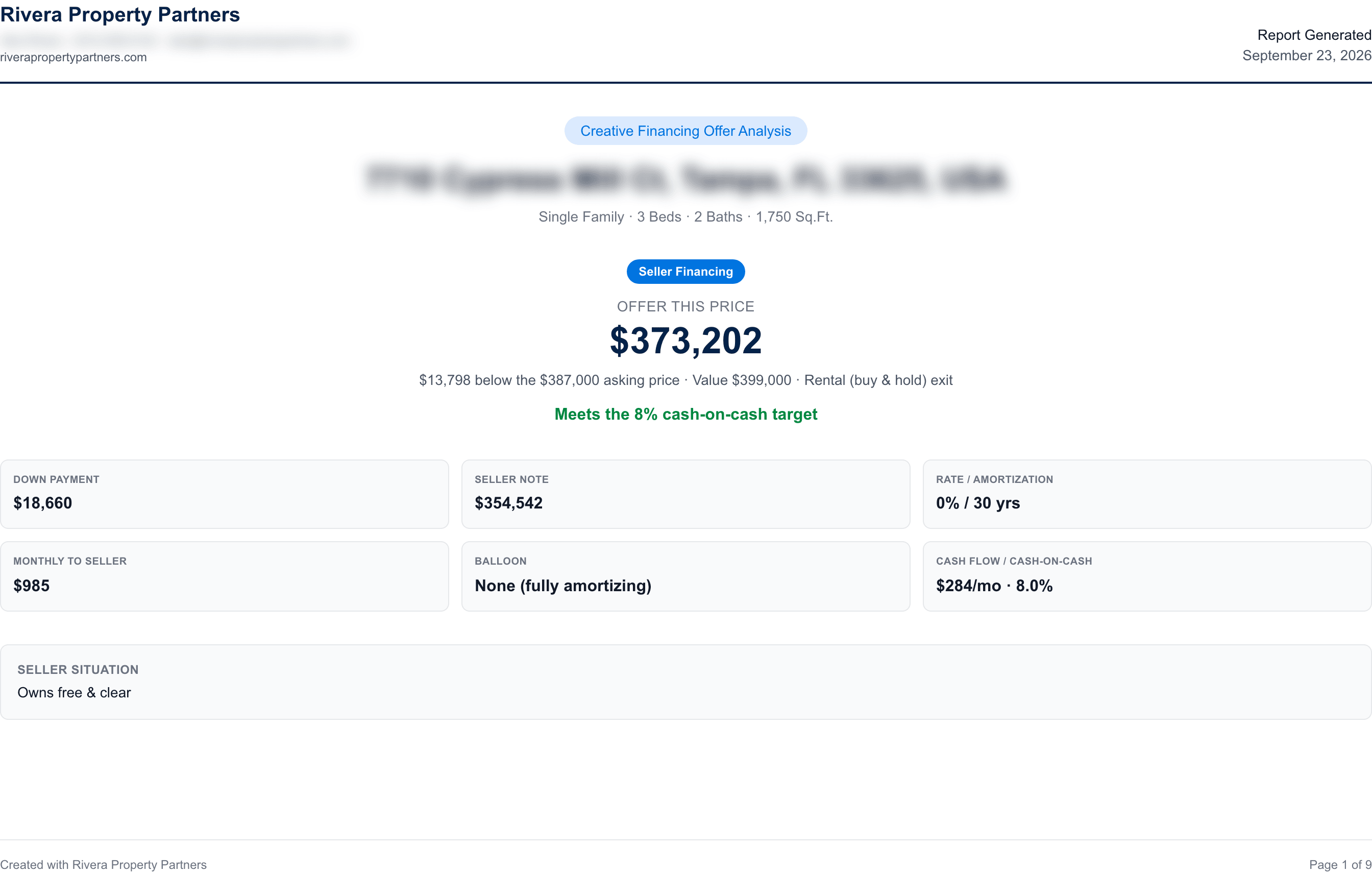
The deal at a glance
The property, the seller's situation and the offer, so whoever opens it knows what they are holding before page two.
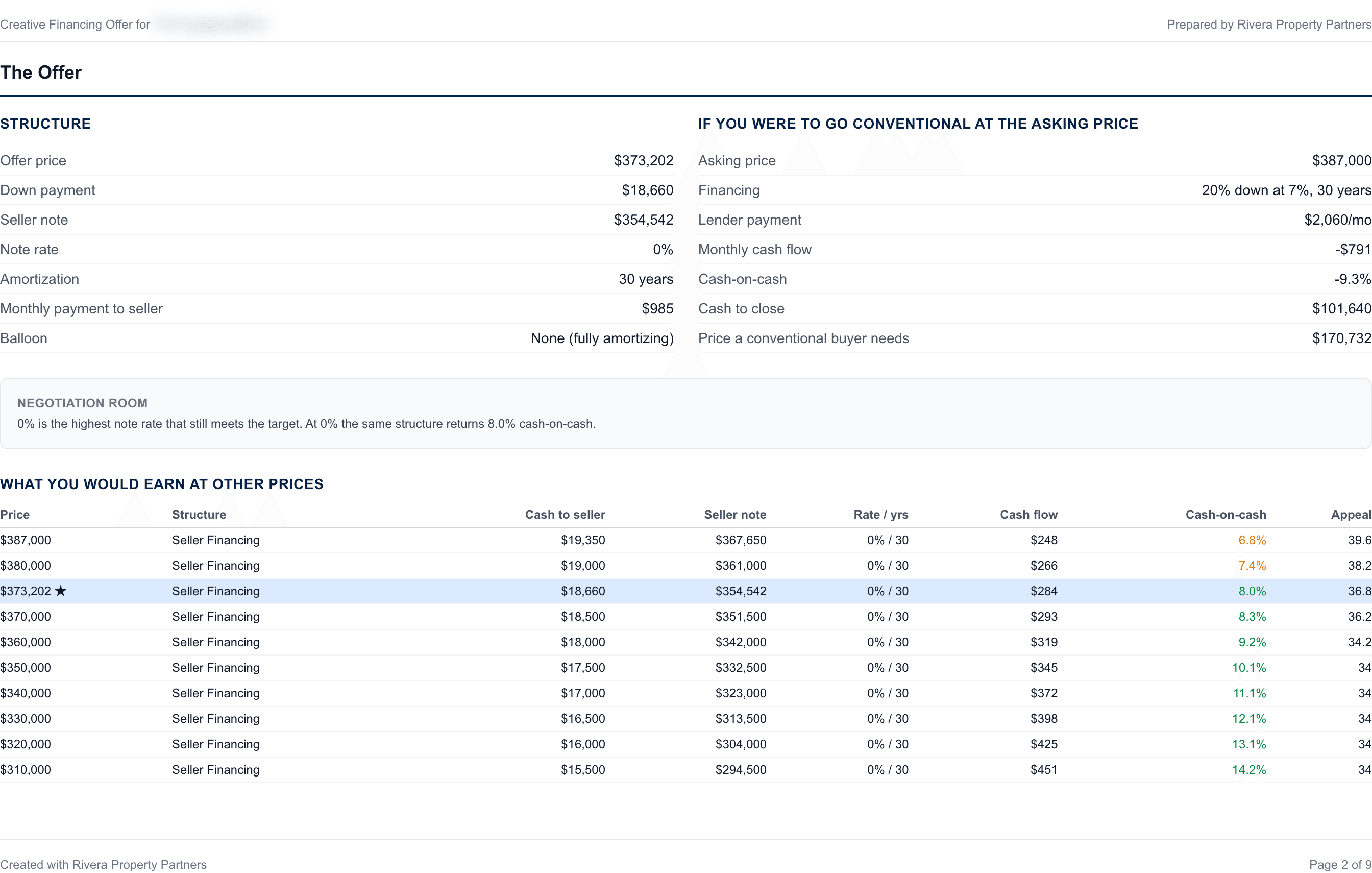
The terms in full
Price, cash at closing, the note, its rate and term, and the balloon - the page a seller's attorney goes straight to.
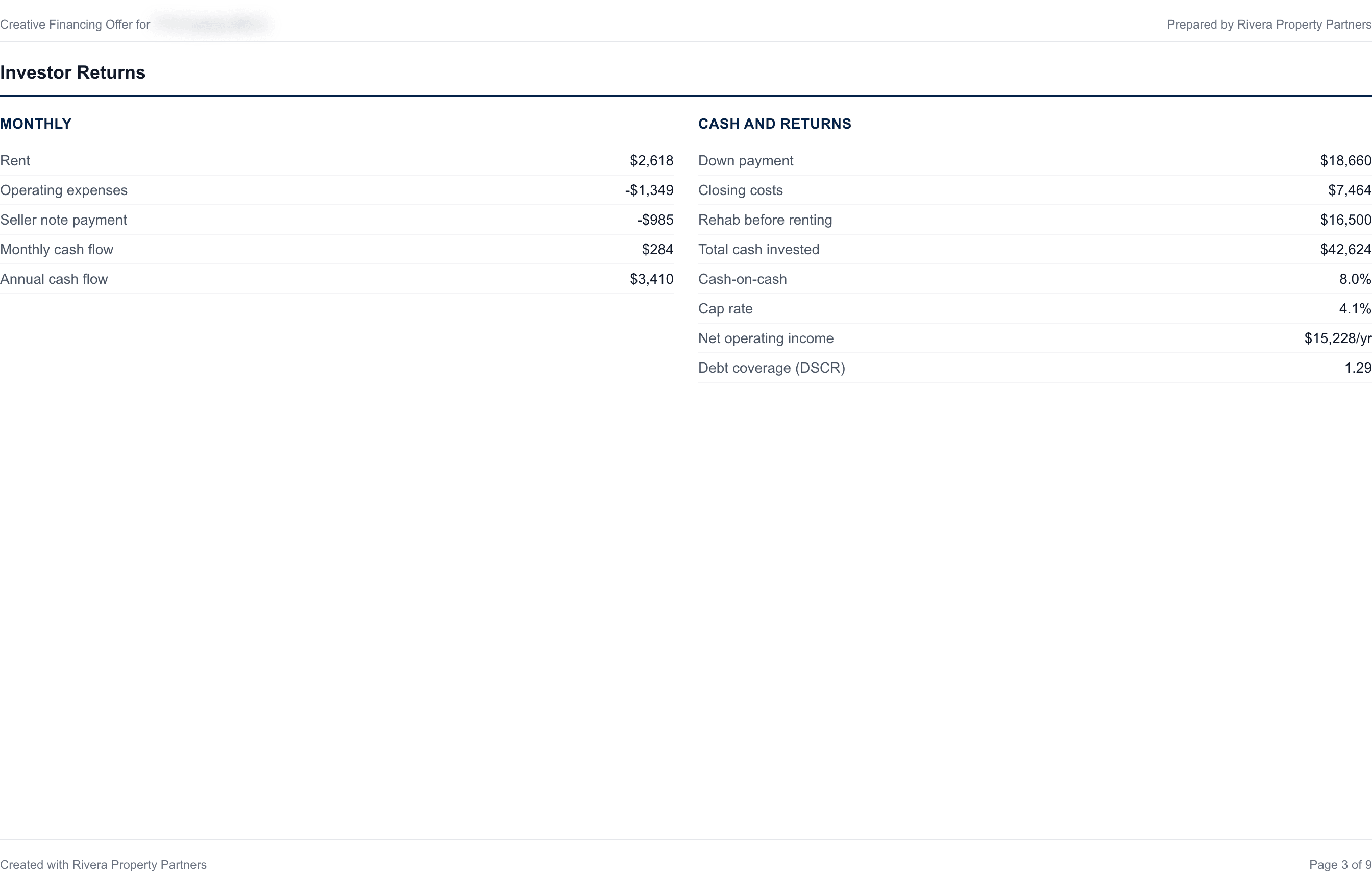
Why it works for you
The rent, the operating expenses and the monthly cash flow against the cash you put in: the page a lender asks for.
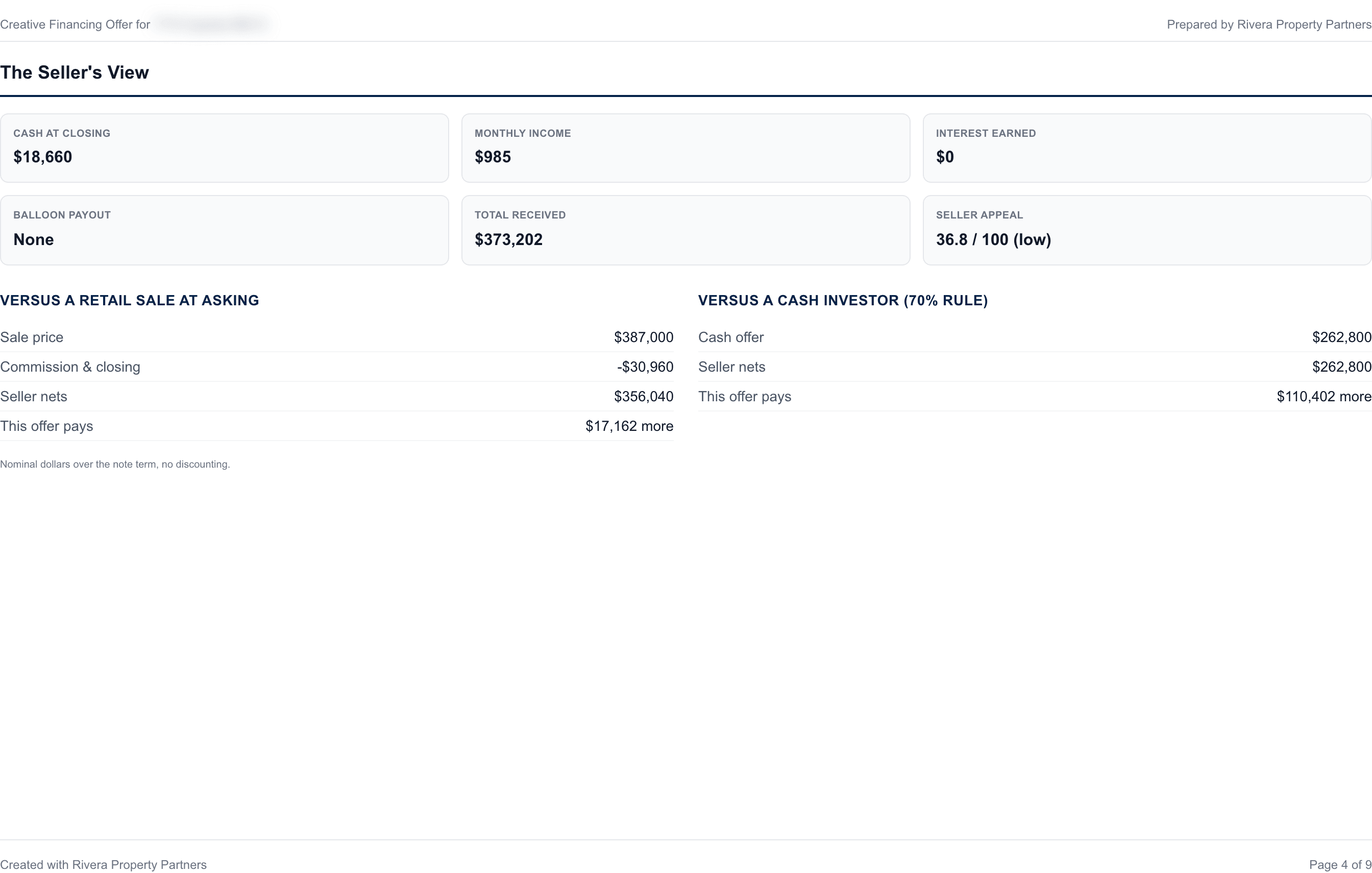
Why it works for them
Cash at closing, monthly income and interest earned, measured against selling today.
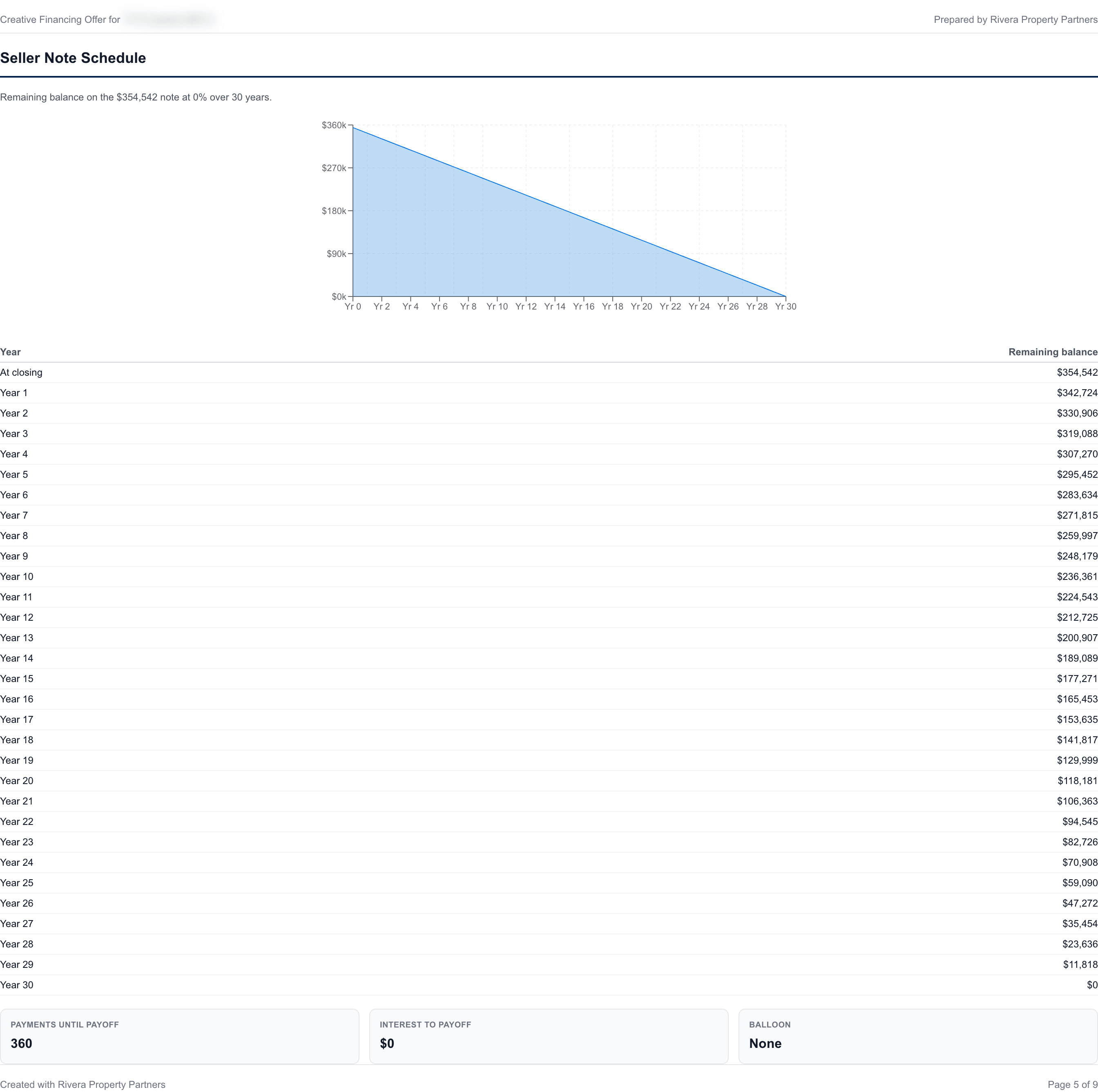
When the money moves
How the carried balance falls year by year and exactly what is owed at the balloon.
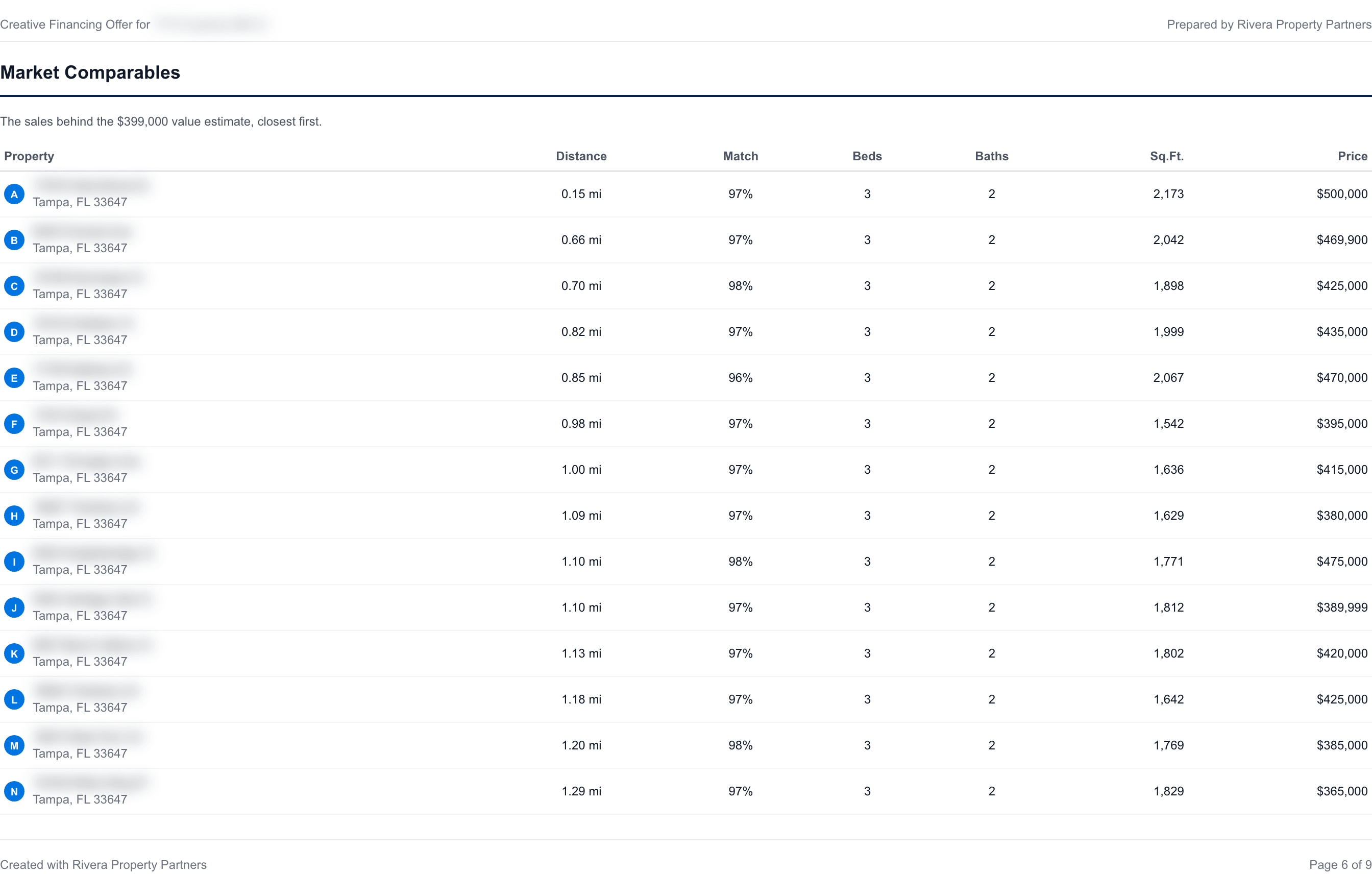
What it is worth
The nearby sales behind the value, one lettered row each, so the price is evidenced.

What it rents for
The nearby rentals behind the rent estimate that the cash flow depends on.
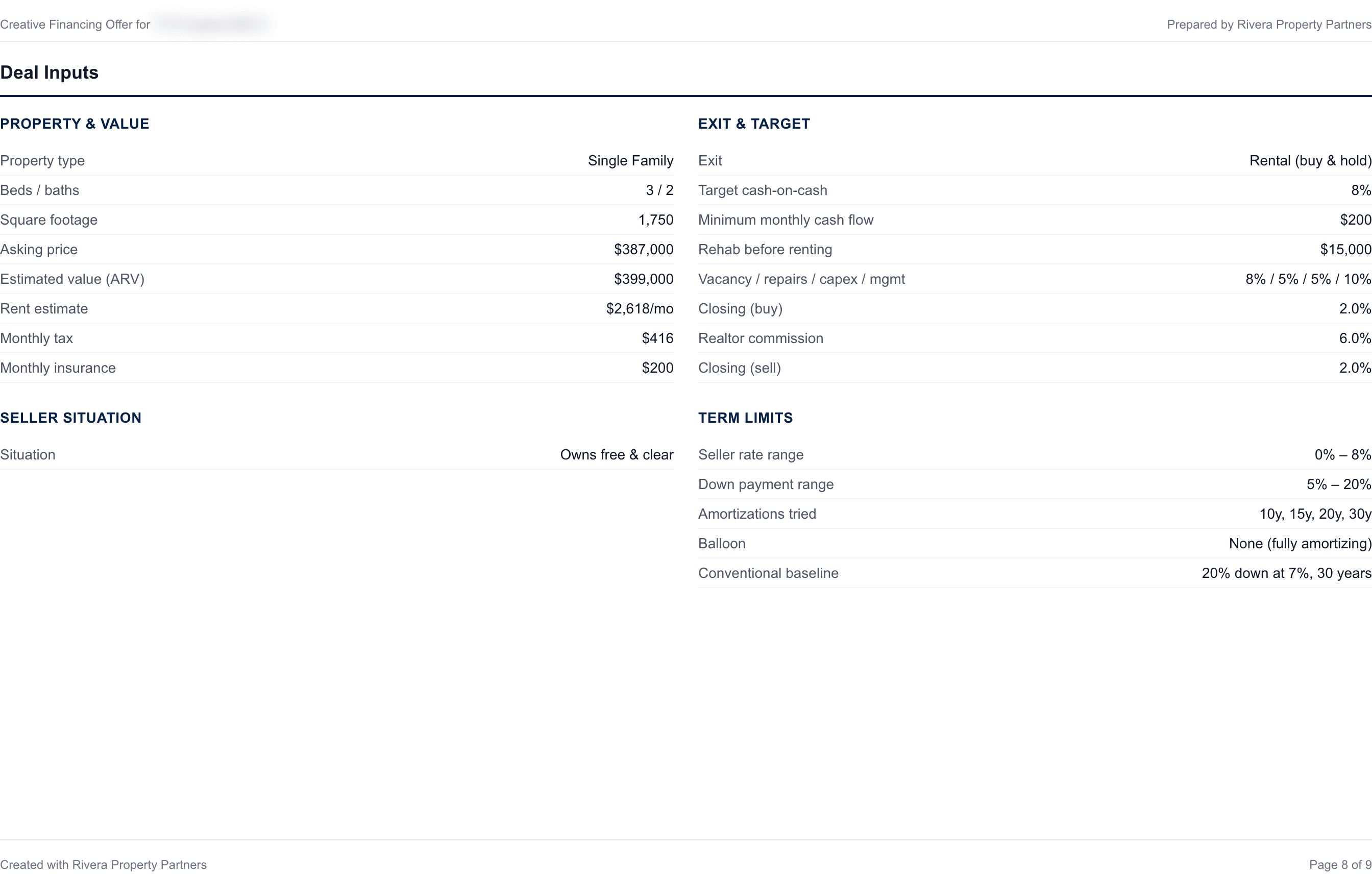
What was assumed
Every figure the offer was built from, so nothing in the packet is unexplained.
Simple, Transparent Pricing
Full access for 7 days free, then continue if you love it
30-day money-back guarantee
Not happy after the trial? Contact us within 30 days of your first payment and we refund it in full. First-time subscribers; renewal payments don't apply. Terms
Full Access
Everything you need to build offers a seller will take
billed annually ($155.88/year)
Plus every other tool in the platform — see all 18 features
7-day free trial · cancel anytime during the trial, no charge. Also available at $19.99/month.
Why Creative Financing Beats a Higher Cash Offer on a Rental
Two buyers walk into the same living room. One offers the seller a cash price that clears their mortgage and leaves a little over. The other offers more than the asking price, pays part of it at closing, and asks the seller to carry the rest as a note at a rate the seller chooses. The second buyer wins more often than people expect, and not because the seller cannot do arithmetic.
A cash offer is capped by what the numbers support. Whatever return a buyer needs comes straight out of the price, which is why a cash investor's best number is so often well under what a seller believes the property is worth. Terms break that link. When part of the price arrives over years instead of at closing, the buyer's money goes further and the seller's total goes up. The trade is time for price, and for a seller with no mortgage and no rush, time is the cheaper thing to give.
Seller Financing: When the Owner Has No Mortgage
An owner who has paid off the property has something unusual: they can be the bank. In a seller-financed purchase the buyer pays a down payment at closing and signs a note for the balance, secured by a mortgage on the property exactly as a lender would be. The seller gets monthly income, interest on money they were not otherwise earning interest on, and a total across the life of the note that beats what a cash sale would have left them after commission.
The four numbers that decide such a deal are the price, the down payment, the interest rate and the amortization. A longer amortization lowers the payment and lets the buyer pay more. A higher rate pays the seller more and thins the buyer's margin. Solving them by hand is guesswork, because moving one moves the rest. Work backwards from the return you need and there is only one set of terms that fits.
Subject-To: When the Seller Still Owes
Most sellers are not free and clear, and that is not the obstacle it looks like. A property bought subject-to leaves the existing mortgage in place and in the seller's name while the buyer takes over the payments. A loan written a few years ago at a rate no lender offers today is worth real money, and taking it over is how a buyer captures that value instead of replacing it with an expensive new loan.
What is left to negotiate is the seller's equity: the gap between what they owe and what they want. That gap can be paid in cash at closing, carried as a second note, or split between the two. When the equity is small the deal simplifies into a straight subject-to purchase with nothing carried at all.
Two cautions belong in any honest description. Nearly every mortgage contains a due-on-sale clause allowing the lender to call the balance when the property changes hands, and that risk does not disappear because the payments are current. And the payment a seller quotes is usually not the loan payment: it is the loan payment plus escrowed taxes and insurance. Treating the whole figure as debt service double-counts costs that belong on their own lines, which quietly makes a bad deal look workable.
The Balloon Is a Deadline, Not a Detail
Few sellers will wait thirty years to be paid in full. The usual compromise is a note amortized over a long term with a balloon after five or seven years, when the remaining balance comes due at once. That structure gives the buyer an affordable payment and the seller a date, and it works as long as the buyer has a plan to meet it - a refinance once the property season, or a sale before then.
A balloon becomes a problem when nobody looks at the schedule until the year it arrives. Knowing the exact balance on that date, from the day the offer is written, is the difference between a planned refinance and a forced sale.
Why Buy and Hold Is the Exit Creative Terms Are Built For
Seller financing and a long-term rental fit together because both are paid monthly. A carried note is a payment, rent is a payment, and the whole question is whether one covers the other with enough left over. That is why every offer here is solved to a cash-on-cash return and a minimum monthly cash flow rather than to a resale number: a buy-and-hold investor is buying an income stream, and the terms are the price of that income.
It also changes what you can afford to pay. A rental financed conventionally has to clear a twenty per cent down payment and a market interest rate before the first dollar of cash flow appears, which is what caps a normal buyer's price. Replace that mortgage with a seller-carried note at a rate you negotiated and a term you chose, and the same rent supports a materially higher purchase price. The gap between those two numbers is the whole opportunity in creative real estate financing.
The figures that decide a buy-and-hold deal are the ones the analysis leads with: monthly cash flow after vacancy, repairs, capital expenditure and management; cash-on-cash return on the money you actually put in; the cap rate; and the debt service coverage ratio a lender will ask about when you eventually refinance. A creative structure that looks generous to the seller and still clears all four is a deal. One that only clears them by assuming no vacancy and no repairs is a spreadsheet.
What Makes a Seller Say Yes
Sellers rarely reject creative terms on the maths. They reject them because nobody explained them. An offer that arrives as a structure - price, cash at closing, what they carry, at what rate, for how long, and what the total comes to - is an offer a seller can take to their attorney. An offer that arrives as a paragraph about "flexible terms" is an offer they will not answer.
The strongest argument is almost never the price. It is the total. A seller comparing a cash offer against a carried note is usually comparing one number against a larger number spread over time, plus interest they would not otherwise earn. Put both side by side, in their terms and not yours, and the conversation changes.
What Investors Ask Before Their First Creative Deal
The Next Seller Who Says No to Your Price
Ask them a different question. Build the seller financing terms, send the proposal, and find out what they would say to a total instead of an offer.
Start Your Free Trial- 7-day free trial
- Cancel anytime
- 30-day money-back guarantee